The short version
- Lead sites sell you enquiries. You pay whether or not you win the job, and so do the other trades quoting for it.
- They’re good when you’re starting out or the diary’s gone quiet. They’re expensive as a way of life.
- A website of your own costs once, ranks for your trade and your town, and the enquiries come straight to you.
- Most trades do best with a site of their own, a Google Business Profile with real reviews, and a lead site only when they need to fill gaps.
I was a builder for eight years before I started building websites, so I’ve had the Checkatrade calls and I’ve paid for MyBuilder leads that went nowhere. Lead sites aren’t a con. They do what they say. The question is whether what they do is worth what they cost, and whether there’s a better place for that money.
How lead sites work
Checkatrade, MyBuilder, Rated People, Bark and the rest all work on roughly the same idea. A homeowner posts a job or searches a category, and the site puts your profile in front of them alongside a handful of other trades. You pay for that, in one of two ways:
- A membership fee. A fixed monthly cost for being listed, whether you get any work from it or not. Checkatrade works like this.
- A fee per lead. You pay when you express interest in a job or when the customer shortlists you, win or lose. MyBuilder and Rated People work like this.
Either way, the same job is usually offered to several trades at once. That’s the business model: the site gets paid several times for one job, and only one of you gets it.
What they’re good at
To be fair to them, lead sites do three things well.
- A fast start. If you’ve just gone self-employed and nobody knows you, a lead site can have enquiries coming in next week. Nothing else does that.
- Filling gaps. When the diary goes quiet, you can turn the tap on. When it’s full, you can turn it off.
- Borrowed trust. Customers recognise the badge. For a trade with no reviews of their own yet, that counts for something.
The catch
The problems only show up once you’ve been on one for a while.
- You pay for leads you don’t win. On a per-lead site, four trades might pay for the same bathroom and three of them get nothing. Over a year that adds up to a lot of money for other people’s jobs.
- The customers are price-shopping. Someone who posts a job to a lead site has asked for several quotes on purpose. You’re competing on price before they’ve even seen your work.
- Your profile looks like everyone else’s. Same layout, same badge, same little photo grid. There’s nothing to show why you’re worth more than the trade listed under you.
- You’re renting your reputation. Every review a customer leaves on a lead site belongs to that site. Stop paying and the profile goes, and years of reviews go with it. Google reviews are yours for as long as Google exists.
- It doesn’t help word of mouth. When someone’s given your name to a friend, that friend wants to look you up. A lead-site profile isn’t much of a place to send them.
What your own site does differently
A website of your own is the opposite of a lead site in almost every way. It costs once rather than forever, it shows your work the way you want it shown, and nobody else is listed on it.
- It’s yours. Your domain, your photos, your words, your reviews pulled in from Google. Nobody can switch it off because you stopped paying a subscription.
- It ranks for your trade and your town. Someone searching “kitchen fitter Glasgow” can find you directly, without a lead site in the middle taking a cut.
- The enquiry comes to you alone. No shortlist, no four other quotes. The customer has already seen your work and decided they like it.
- It works with word of mouth, not instead of it. Recommendations still bring most trades most of their work. The site is where those people land when they look you up.
- It shows the work properly. A gallery of your own jobs, grouped by type, with the finish visible. That’s what wins bigger jobs, and it’s exactly what a lead-site profile can’t do.
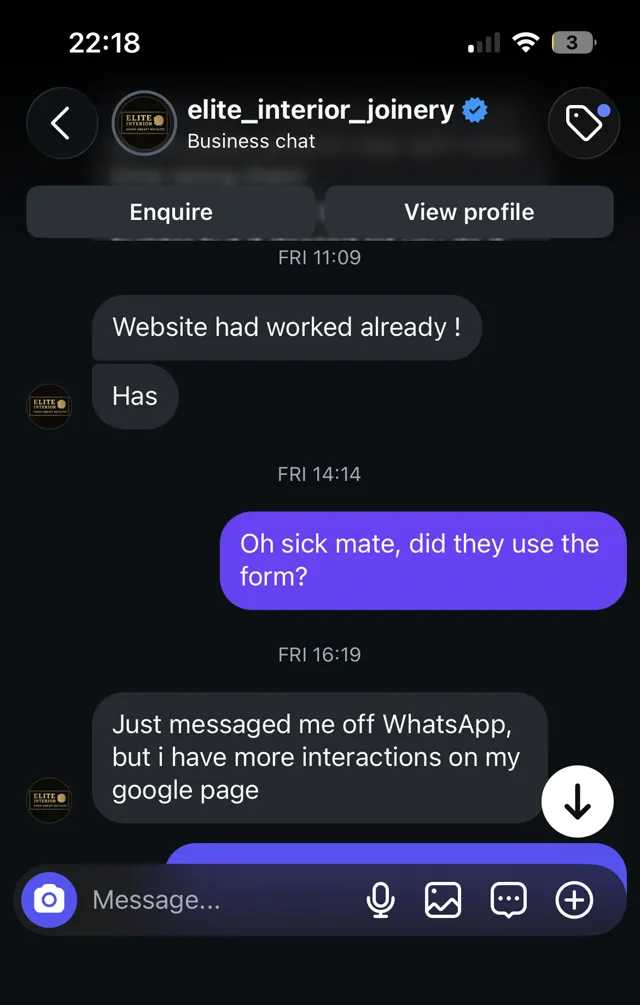
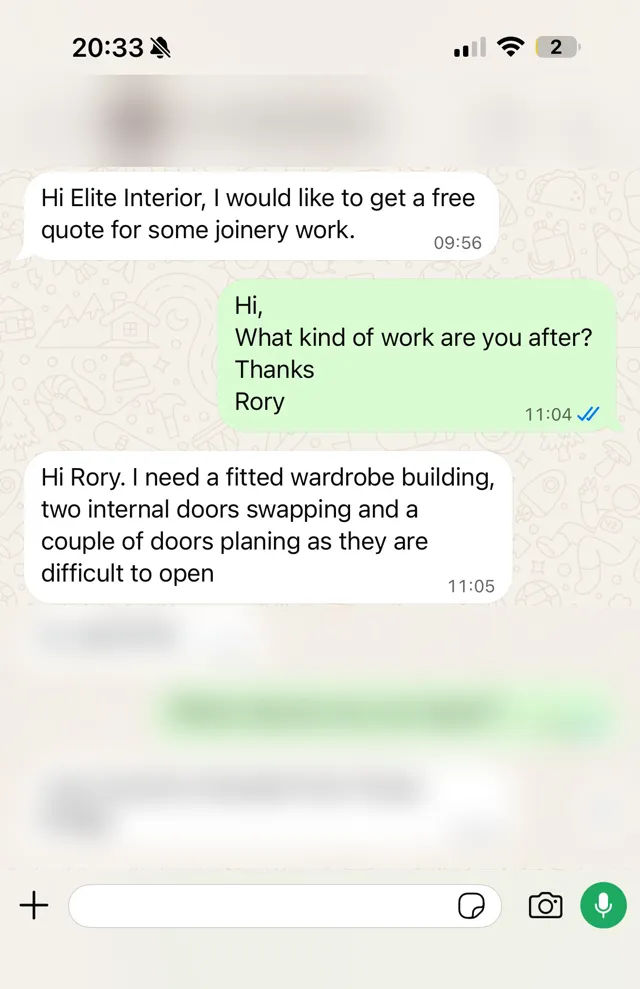
An example. Elite Interior, a joiner in Huddersfield, was getting work through Instagram and MyBuilder. I built him a website of his own, and two weeks after it went live a homeowner used it to ask for a quote for a fitted wardrobe and internal doors. No lead fee, no shortlist, no other quotes. Read the case study.
Using both
This isn’t all or nothing. Plenty of trades keep a lead site going while their own site builds up, and that’s sensible. A few things make the two work together rather than against each other:
- Ask for reviews on Google, not the lead site. Google reviews show up in search, on your Business Profile and on your website. Lead-site reviews only show up on the lead site. How to ask.
- Put your website address on your profile. Serious customers will click through, see the full gallery and reviews, and you’ve just separated yourself from the other three quotes.
- Ask every customer where they found you. After six months you’ll know exactly what each source is earning you, and whether the lead site is paying for itself.
- Turn the lead site off when you’re busy. There’s no point paying for enquiries you’ll have to turn down.
What each one costs you
I’ve kept prices off this table because lead sites change theirs often and they vary by trade and area. The shape of the cost is what matters.
| Lead site | Your own website | |
|---|---|---|
| How you pay | Monthly fee, or a fee for every lead you go for | Once for the build, then a small hosting cost |
| Who else is there | Several trades quoting for the same job | Only you |
| Who owns the reviews | The lead site | You, via Google |
| What happens if you stop paying | Profile and reviews disappear | You keep the files and the domain |
| Time to first enquiry | Days | Weeks to months, then it keeps going |
| Type of customer | Comparing quotes | Already looked you up and liked what they saw |
For what it’s worth, my sites start from £295 with 12 months’ hosting included, then £19 a month, and you only pay once you’ve seen it and you’re happy. More on what a trade website should cost.
How to decide
Three questions:
- Are you new, with no reviews and an empty diary? Use a lead site to get going, and ask every customer for a Google review. Plan to need it less each month.
- Are you established and getting most work by recommendation? You need a website more than a lead site. It gives the people who’ve heard your name somewhere to go, and it picks up the searches as well.
- Are you paying a lead site every month and not sure it’s earning its keep? Add up a year of fees. If that’s more than a website would cost, you already have your answer.
Not sure which you are? Read whether a website’s worth it when your work comes from word of mouth, or see what a site of your own would cost.